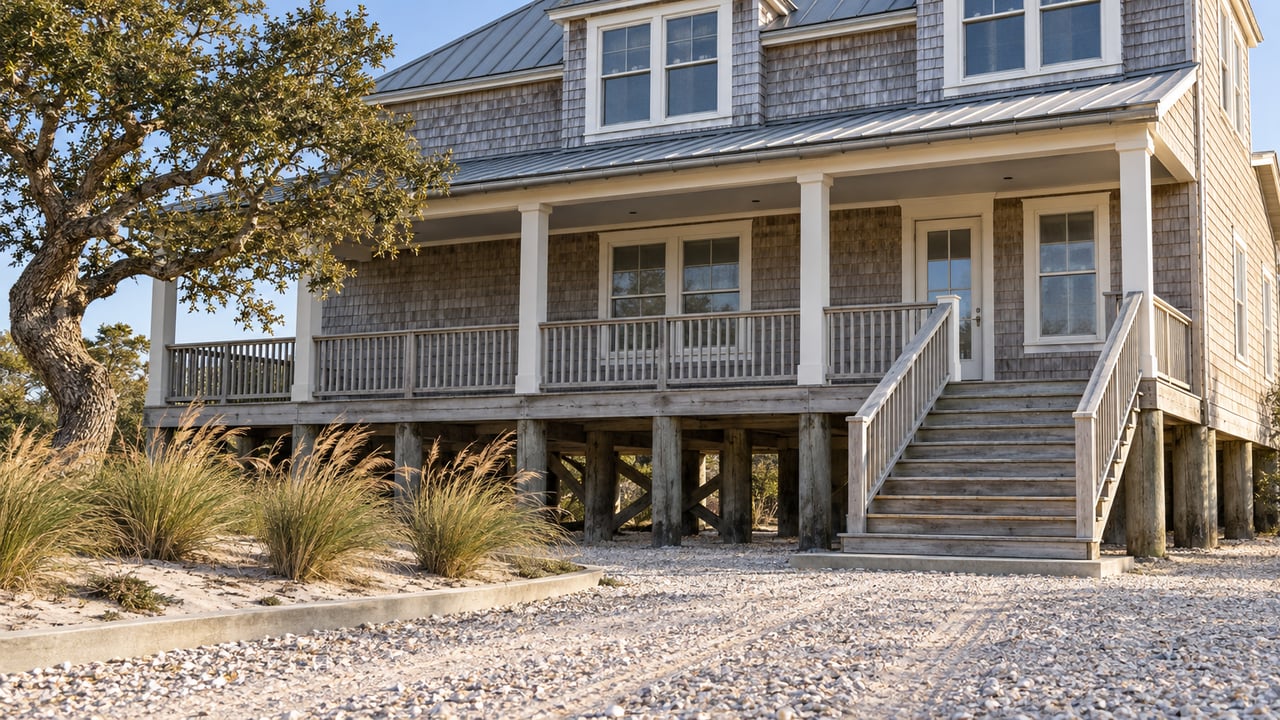
In March 2024, an envelope arrived at homes across Chicahauk, one of the residential subdivisions that make up the town of Southern Shores. Inside was a letter from an attorney at Hornthal, Riley, Ellis & Maland, the same firm that represents the Town of Southern Shores itself. According to the Southern Shores Beacon, the letter informed Chicahauk property owners that starting April 1, the Chicahauk Property Owners Association would begin fining anyone in violation of a covenant restricting guest houses and accessory structures at a rate of $100 per day.
The covenant in question dates to 2010. It says a lot in Chicahauk cannot carry more than one single-family residence, that duplexes are barred outright, and that no guest house, suite, or accessory structure can be rented, leased, or sold apart from the main home. None of that appears in the Town of Southern Shores zoning ordinance. It appears only in a private document.
That gap between what the town permits and what a subdivision's own covenant allows is the thing worth understanding if you're looking at property in Southern Shores and picturing a guest suite, an income unit, or space for extended family. The zoning code tells you what the town will let you build. It does not tell you what your specific lot's recorded covenant will let you build, and in at least one Southern Shores neighborhood, those two answers are not the same.
The Town Code Says One Thing. The Covenant Can Say Another.
The Southern Shores Beacon reports that Southern Shores' zoning code currently permits accessory dwelling units on residential property, with the test for whether a structure counts as an ADU typically coming down to whether it has cooking facilities. No kitchen, no problem, at least as far as the town is concerned.
Chicahauk's covenant doesn't use that test. It doesn't ask whether there's a stove. It prohibits guest houses and accessory structures from being rented or sold separately from the main residence, full stop. At a Town Council meeting in July 2024, officials noted plainly that the Chicahauk Property Owners Association's covenant on this point supersedes the town code.
For a buyer, this means the zoning ordinance is necessary reading but not sufficient reading. It tells you what's legal townwide. It says nothing about what a specific subdivision's declaration allows on the specific lot you're considering.
Eight Neighborhoods, Not One Set of Rules
Southern Shores isn't a single homogenous HOA. It's closer to eight distinct neighborhoods layered under one town government, each with its own history and, in some cases, its own governing document:
- Chicahauk, a soundside community of roughly 554 developed and undeveloped properties with its own covenants enforced by the Chicahauk Property Owners Association
- Sea Crest Village and Pelican Watch, oceanfront subdivisions
- Mallard Cove and Fairway Estates, soundside neighborhoods
- Southern Shores Landing, the newest addition to the town
- the remainder of the town proper, outside those named subdivisions
Layered on top of that geography are two different associations with two different purposes. The Southern Shores Civic Association is a voluntary, townwide group that maintains shared amenities like Hillcrest Beach Access, Sea Oats Park, Soundview Park, and the marina areas. It's the association most people picture when they think about beach parking passes and tennis courts. The Chicahauk Property Owners Association is something else entirely: an association specific to one subdivision.
The Town Doesn't Have a Master List Either
Here's the part that should matter most to a buyer doing due diligence: the Town of Southern Shores itself doesn't maintain a comprehensive inventory of which properties carry ADU-restricting covenants. At the October 2024 Council meeting, Neal suggested that the town try to determine how many properties already have such covenants recorded against their deeds. Council members discussed enlisting help from the Southern Shores Civic Association, the Chicahauk Property Owners Association, and town staff to gather that information.
That's an acknowledgment, in a public meeting, that no single document exists to answer the question a buyer most needs answered: does this lot carry a private restriction the zoning code won't reveal? As of the Chicahauk Property Owners Association's most recent public newsletter in November 2025, there's no indication that inventory was ever completed, or that the fine enforcement effort from spring 2024 was formally resolved one way or the other. The uncertainty about how consistently it's enforced, and about how many other Southern Shores lots carry similar restrictions, is still there too.
Why This Matters If a Rental Suite Is Part of the Plan
If part of your reason for looking in Southern Shores is the idea of adding a guest suite, an in-law unit, or a small accessory rental to offset carrying costs, the town's relatively permissive ADU stance can create a false sense of security. The zoning code says a no-kitchen accessory structure is fine. A subdivision's private covenant can say no accessory structure of any kind can be rented separately, and that rule doesn't care what the town's rule says.
There's also a legislative angle worth knowing. House Bill 409, which would have addressed ADU restrictions at the state level, passed the North Carolina House but stalled in a Senate committee. Even had it passed, it included exceptions for HOA restrictive covenants and historic properties, meaning it would not have overridden a covenant like Chicahauk's. Private, deed-recorded restrictions on accessory structures in Southern Shores are not likely to be solved by a future statewide law. They get resolved, if at all, by a vote of the association's own members, as Ward and Smith explains, and NC Lawyers notes that any amendment to a covenant has to remain reasonable in light of the original intent behind it. That's a higher bar than a simple majority deciding they'd like a change.
What to Actually Ask Before You Write an Offer
A general HOA disclosure isn't the same as the recorded declaration for a specific subdivision. Before you get attached to a plan that involves an accessory structure, guest suite, or rental unit on a Southern Shores property, it's worth confirming:
- Which association, if any, governs this specific lot: townwide SSCA membership, a subdivision-specific POA like the Chicahauk Property Owners Association, or both
- Whether that association's recorded covenants say anything about accessory structures, guest houses, or separate rental of any part of the property
- When those covenants were last amended, and whether any enforcement action has been reported recently
- Whether the seller or listing agent can produce the actual recorded declaration, not just a summary
None of this shows up by reading the Town of Southern Shores zoning ordinance on its own. It requires pulling the specific subdivision's governing documents and reading them the way you'd read any other part of the title.
A Few Direct Questions
Can a covenant like Chicahauk's be changed? Yes, through a membership vote following the process laid out in the covenant itself and in North Carolina's Planned Community Act. Any amendment also has to be reasonable in light of the covenant's original intent, a standard North Carolina courts have enforced in prior disputes over HOA amendments statewide.
Southern Shores rewards buyers who read past the listing sheet, and the town's patchwork of covenants is exactly the kind of detail that separates a smooth closing from a surprise six months in. If you're weighing a property here with an accessory suite or rental potential in mind, Jackson Dixon can help you pull the actual governing documents for that specific subdivision before you're too far into the process to adjust course. Search Properties to see what's currently available across Southern Shores and the surrounding towns.
This article is general information, not legal, tax or financial advice. Consult a qualified professional about your situation.