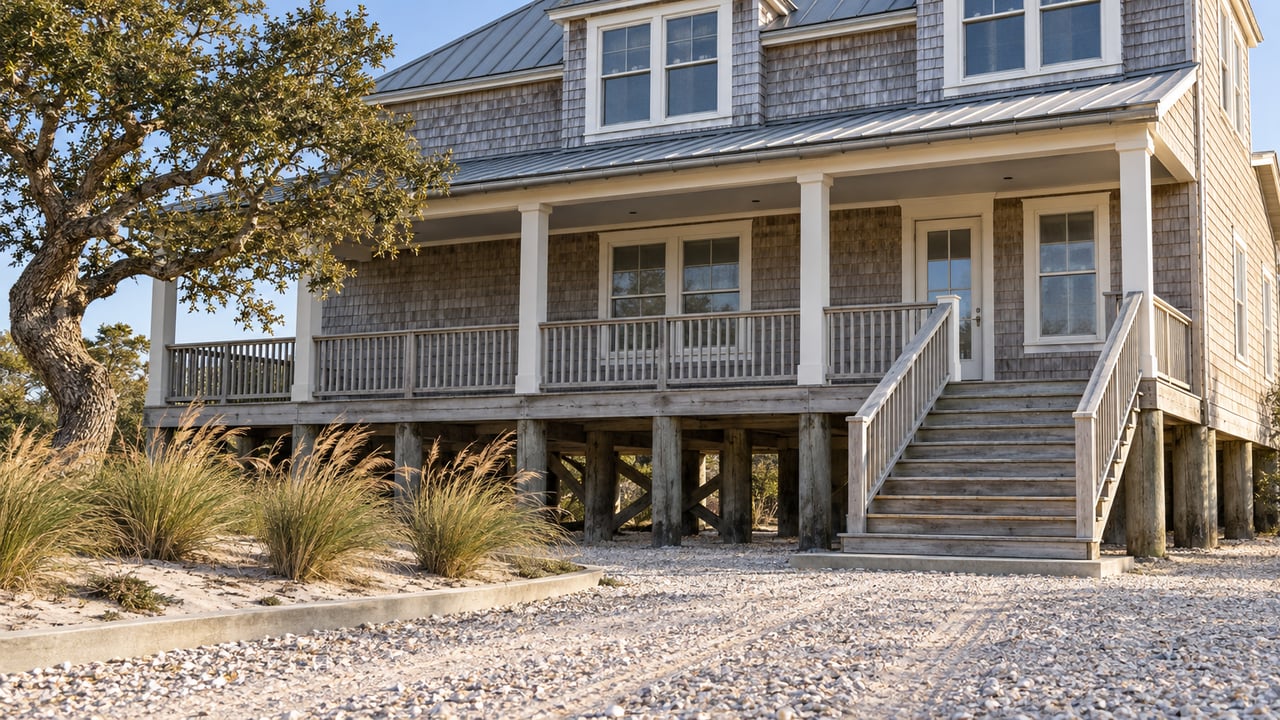
Picture two listings that turn up in almost any Kill Devil Hills search this year, both asking under $650,000. One sits two lots back from the ocean in the old Avalon Beach section, a modest three bedroom cottage with a carport and just over a thousand square feet. The other sits on Bay Drive along Kitty Hawk Bay, a newer build with a two car garage, sound views from the primary suite, and more than twice the living space. A buyer who only checks the town-wide median price for Kill Devil Hills online has no way to guess which one is priced fairly and which one is the better buy.
That confusion is baked into any number that tries to describe a town built out of four separate real estate markets. And it matters more than usual right now, because the town-wide median just did something that looks like a simple price drop and is not quite that simple.
Kill Devil Hills Runs on Four Markets, Not One
Locals describe Kill Devil Hills in four bands, and the geography is easy to trace on a map. Oceanside covers everything east of the Beach Road, known officially as Virginia Dare Trail, where elevated cottages on pilings and vacation-rental stock dominate. Avalon Pier, the town's working fishing pier at Milepost 6, sits right in the middle of this stretch and has for decades.
Between the Highways is the strip separating the Beach Road from the four-lane Bypass, a mix of smaller cottages, low-rise condos, and a growing number of full-time residences that get a short walk to the sand without oceanfront pricing. West of the Bypass is Westside, where lots get bigger, garages become standard, and the housing stock shifts toward year-round living rather than weekly rental turns. Bay Drive, a three mile road tracing the Kitty Hawk Bay shoreline, threads through this zone and connects several soundfront pockets. Furthest west sits Colington, almost entirely residential, and built around canals and sound access rather than beach walks.
| Zone | Location | Typical Housing | Character |
|---|---|---|---|
| Oceanside | East of Virginia Dare Trail | Elevated cottages, condos, larger rental homes | Vacation-rental dominant |
| Between the Highways | Beach Road to the Bypass | Smaller cottages, condos, mixed use | Walkable, moderate pricing |
| Westside | West of the Bypass | Larger lots, garages, ground-level construction | Primarily year-round |
| Colington | West of Westside | Canal and soundfront homes | Almost entirely year-round |
Four zones, four different buyer profiles, and four different price ceilings. Averaging them into a single town-wide figure is a bit like averaging the price of a studio apartment and a townhouse and calling it the median cost of housing in a city.
What the Town-Wide Median Actually Averaged in Early 2026
In February 2026, Kill Devil Hills homes sold at a median price of $541,000, down 15.7 percent from the same month a year earlier, according to Redfin's tracking of MLS and public records. Only 15 homes closed that month, down from 21 the year before. On the surface, that reads like a market losing value fast.
Here is the detail that changes the story: over that same window, the median sale price per square foot in Kill Devil Hills was $366, up 4.0 percent year over year. A town where homes are supposedly getting cheaper does not usually see the price per square foot climb at the same time. Those two numbers moving in opposite directions are the real signal, and they point toward a shift in what sold rather than a drop in what things are worth.
A falling median price and a rising price per square foot in the same month usually means the mix of homes changed, not the value of any single home.
Why the Mix, Not the Values, Moved
Kill Devil Hills homes run smaller on average than the rest of Dare County. Typical square footage in town sits around 1,825 square feet, against a county average closer to 2,153. Some of that gap traces directly to Avalon Beach, the town's oldest neighborhood, where original flat-top cottages from decades ago still make up a real share of the stock in the Oceanside and Between the Highways bands.
If more of what closed in a given month came from that smaller, older end of the inventory, a lower median price and a higher price per square foot can show up together without a single home actually losing value. Smaller homes selling at strong per-square-foot pricing will always pull the overall median down even while per-foot values hold or climb. That is a compositional shift, and it is the more likely explanation here than an across-the-board price decline, though it is worth saying plainly that neither Redfin's data nor mine can prove causation with certainty. It is a read that fits the numbers, not a verdict.
Days on Market Give a Mixed Picture Through the Spring
Days on market offer another view of market conditions. In February 2026, homes in Kill Devil Hills averaged 90 days on market, up from 57 days a year prior. By April 2026, Movoto's tracking showed a median of 77 days, flat against the same month in 2025. By mid-June 2026, a 30-day snapshot of local activity showed 44 new listings against only 34 closings, a net gain in inventory, with average days on market at 67 and homes selling for roughly 96 percent of asking price.
The checkpoints give a mixed picture: February's average was up year over year, April's median was flat year over year, and the mid-June snapshot showed more new listings than closings. That is not a market in free fall. It is a market where sellers still have room to price with confidence, but buyers have gained real room to negotiate, especially on homes that sit outside the tightest rental-income zones.
Reading the Median Correctly When You're Actually Shopping
None of this means the town-wide median is useless. It means it needs a zone attached before it tells you anything about a specific house. A buyer comparing a Westside primary residence against the town-wide Kill Devil Hills figure is comparing it to a number that includes small Oceanside rental cottages built in a different decade for a different purpose. A seller with a soundfront home on Bay Drive who prices against the town median risks leaving real money on the table, because that median is dragged down by smaller inventory that never competed with soundfront pricing in the first place.
The useful move is to pull comps from inside the same zone, and ideally from the same side of the same road, before trusting any single figure. A $541,000 median sold price in February tells you almost nothing about what a 2,400 square foot Westside home with a garage should cost. It tells you a lot more about the smaller end of the Oceanside and Between the Highways stock that happened to close that month.
Frequently Asked Questions
Is Kill Devil Hills actually getting cheaper? The data through the first half of 2026 does not support a broad decline in value. The falling median sale price alongside a rising price per square foot points toward a change in which homes sold, not a drop in what comparable homes are worth.
Why did average days on market rise year over year in February? The figures show that February’s average was 90 days, up from 57 a year earlier, but they don’t establish why it rose. A later 30-day snapshot from mid-June 2026 showed 44 new listings against 34 closings, suggesting inventory was building faster than sales were closing. More choices for buyers can stretch the time it takes any single home to sell.
Which zone tends to hold value best for a primary residence versus a rental? Westside and Colington homes are built primarily for year-round living, with larger lots and garages, while Oceanside and Between the Highways carry more of the town's short-term rental stock. Neither is inherently a better investment. The right fit depends on whether the goal is full-time living, rental income, or some mix of both, and that math looks different in each zone.
Numbers like these are only useful with the right zone attached, and that is the kind of read that comes from watching a specific stretch of road, not a countywide spreadsheet. If you are trying to figure out what a Kill Devil Hills price actually means for the home you are looking at, Jackson Dixon can walk through the comps zone by zone. Search Properties to see what is currently on the market across Kill Devil Hills and the surrounding Outer Banks towns.